A year ago, a Google search for a "review" brought up an AI-written summary less than a third of the time. By August 2026, it was close to nine times in ten.
The data comes from a Semrush study published on 21 October 2026, which tracked how often Google AI Overviews appeared on the searches people make when they're close to a decision: reviews, prices, comparisons, alternatives and "best X for Y". Across the 400 keywords it followed, coverage nearly doubled in a year.
Whilst the study only covered three industries in the US (banking, software and ecommerce), the principles for appearing in AI Overviews are the same for service businesses around the world. Your customers use the same types of searches when they're deciding who to call for building work, a cafe to go to for lunch, or need a lawyer to handle a legal matter.
We've put together this guide to show you how to appear in Google AI Overviews for those searches, what the Semrush study found, and what it missed.
Quick answer
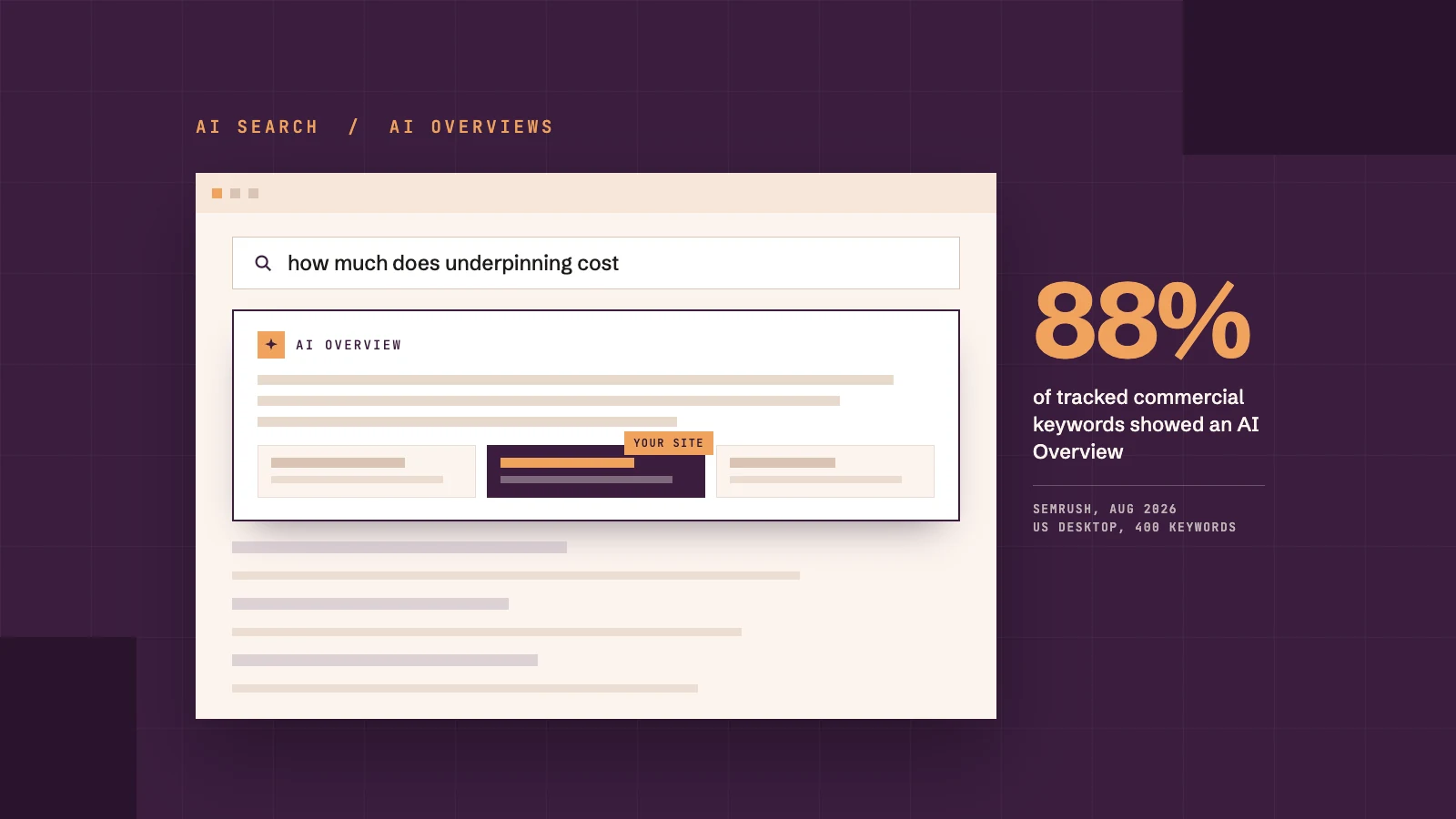
To appear in Google AI Overviews, a page must be indexed and eligible for a snippet in Google Search, and Google says no special markup or files are needed. The useful work is letting Google crawl your key pages, answering pricing and comparison questions in plain text, and keeping your Business Profile and reviews accurate. It matters more now: a Semrush study found AI Overviews on 88% of the commercial keywords it tracked.
What does it take to appear in Google AI Overviews?
If you're wondering how to appear in Google AI Overviews, you're not alone: a lot of our customers are asking the same question. Unfortunately, there's no special trick that guarantees a citation, and Google says so directly. There are also no extra requirements you need to add to your website for AI Overviews.
That doesn't mean it's down to luck. The first requirement is that Google can index the page and show it in Search with a snippet. After that, the groundwork that helps you rank in the normal results also helps you appear in the AI summary above them, and much of it can improve your chances of being recommended by ChatGPT too. Here's where to start.
Make sure Google can reach your key pages
Google's checklist includes allowing crawling in robots.txt and through your CDN or hosting setup, and linking to important pages from elsewhere on your site. Firewalls and security plugins can block crawlers without anyone noticing, so check in Google Search Console that your service pages are indexed. It's one reason ongoing website care earns its place.
Answer buyers' questions in plain text
Google recommends keeping important content in text. Semrush advises keeping pricing and comparison pages current, because outdated details give the summary room to describe you inaccurately. For a service business, this means having information that clearly states what affects your prices, what's included, who you suit and which areas you cover.
It's the same work that supports ordinary rankings. When we built location pages and supporting content for piling contractor Dart & Co Foundations, their published results showed organic traffic up 129% over 12 months, with top-five positions for priority regional searches. That project was measured on organic search, not AI Overviews, but it's the kind of specific, location-by-location content Google has to draw on.
Keep your Google Business Profile accurate
Google's guidance specifically mentions keeping Business Profile information up to date. Hours, services, categories and service areas should match your website. For Steele Financial, an accountancy firm we've done local SEO for, Business Profile interactions were up 353.3% in May to August 2026, compared with the same months in 2025, just from keeping their profile updated regularly. Interactions include calls, messages, direction requests and website clicks, so they show people taking action rather than just looking, even if not every one turns into an enquiry.
Look after the sites that describe you
AI summaries draw on review sites, directories and videos as well as your own pages. Semrush suggests finding which review platforms appear as sources for your key searches and building reviews there, within each platform's rules. Check what those listings say about you and correct anything that's out of date.
What did the Semrush study find?
Semrush found that Google AI Overviews appeared on 88% of the commercial keywords it tracked in August 2026, up from 45.75% in September 2025. To get there, it built a fixed list of 400 keywords across three industries and five types of decision-stage search, then checked US desktop results every month to see whether Google showed an AI Overview for each one.
Review searches moved furthest:
Search type
Example from the study
Sept 2025
Aug 2026
Reviews
Example from the study"chase checking account review"
Sept 202530.14%
Aug 202689.04%
Best X for Y
Example from the study"best credit union for car loan"
Sept 202542.72%
Aug 202696.12%
Price and cost
Example from the study"price antivirus software"
Sept 202543.59%
Aug 202682.05%
Alternatives
Example from the study"crowdstrike alternatives"
Sept 202548.44%
Aug 202682.81%
Brand vs brand
Example from the study"hubspot vs salesforce"
Sept 202563.41%
Aug 202686.59%
AI Overviews were even more common on the searches people make most often. When Semrush weighted each keyword by how many people search for it, coverage rose to 97.08%. The 12% of keywords with no AI Overview made up less than 3% of all the estimated searches in the sample.
The study also shows that Google doesn't only quote the businesses being compared. For "mailchimp vs klaviyo", the summary used Klaviyo's own guide to explain when to choose Klaviyo, but turned to a third-party site, Zapier, and a YouTube video to explain when to choose Mailchimp. For a service business, that means the summary describing you could be built from someone else's words.
What doesn't the study tell us?
The study doesn't tell us how often AI Overviews appear across all Google searches, on mobile or outside the US, or whether they cost businesses any clicks. The 88% is a share of 400 chosen keywords, so a few limits are worth keeping in mind:
It's US desktop only. There's no mobile data, and nothing from other countries.
It measured appearances, not clicks. As PPC Land points out, it can't show whether businesses lost website visits because people read the summary instead of clicking through.
The groups are small. PPC Land estimates fewer than 27 keywords in each industry-and-search-type group, so one keyword can shift a group's figure by several points.
Semrush has a commercial interest. It sells tools for tracking AI Overview visibility, which is exactly what its recommendations suggest you do. That doesn't make the findings wrong, but it's worth knowing.
Bigger samples give very different figures. SISTRIX put AI Overviews on around a fifth of German keywords earlier this year, across more than 100 million keywords. The fair reading is narrower: for decision-stage searches in the sectors Semrush tracked, an AI summary is now the norm.
Why does this matter for a small service business?
Because these are the searches your customers make right before they choose who to hire. If Google answers them with an AI summary, that summary may be the first thing a potential customer reads about your type of service, and it may quote a directory, review site or competitor rather than you.
Think about how that plays out in your own sector. Someone searching "accountant in Bristol reviews", "how much does underpinning cost" or "best electrician for EV charger installation" is asking the same kinds of questions Semrush tracked. Searching these phrases yourself will allow you to see whether Google answers them with an AI Overview, and whose website it quotes.
What these AI overviews mean for your website traffic is less clear. Semrush says ranking first probably won't bring the traffic it did a year ago, although its study didn't measure traffic. Google says people who click through from results with AI Overviews tend to spend longer on the site. The clearest answer for your business will come from your own data, and the next section shows you where to look.
How can you tell whether AI Overviews are affecting you?
No single tool gives a clean answer, but you can build a reasonable picture:
Check your buying searches regularly. List 10 to 20 searches that could bring you work, such as your main services plus your town or area. Once a month, run them in a private window on your phone and desktop, and note whether an AI Overview appears and which sites it links to. For our own AI visibility monitoring, we use Claude to run the full check, which takes about 20 minutes, then spend 10 to 15 minutes spot-checking a few searches by hand, since results can vary by location and device. That saves us around two hours each time.
Read Search Console carefully. Google counts AI Overview appearances within the overall Web search data, so they aren't shown separately. If impressions hold while clicks fall, an AI Overview is one possible reason, alongside seasonality, ads and ranking changes.
Keep an eye on enquiries, not just visits. If your website traffic dips but calls, forms and bookings hold steady, the people who matter are still finding you. If both drop, it's worth looking more closely at what's changed.
Should you worry if your homepage is getting fewer clicks?
Not necessarily. In an analysis published by Search Engine Land in November 2026, Jenny Lee Lynch compared Google Search Console data for 110 homepages, Q3 2026 against Q3 2025. Three in four homepages (81, or 74%) received fewer organic clicks, with a median fall of 21%. Big losses were less common: 15 homepages (14%) lost half or more of their clicks.
Two findings are worth bearing in mind when you look at your own figures. First, most homepage clicks come from people searching for the business by name. Across 10 of the sites, branded searches made up an average of 79.6% of homepage clicks. Second, a few very large sites skewed the overall picture. Total clicks fell 16% across all 110 homepages, but only 7% once the four largest sites were removed.
The sites in the study were e-commerce, SaaS, education, finance, logistics and healthcare businesses, not local service businesses. Treat the figures as a sign of a wider trend, not a benchmark for your sector. The study also doesn't establish why the clicks fell.
In practice, that means:
Split your homepage clicks in Search Console into searches that include your business name and searches that don't. A fall in branded clicks may mean fewer people are looking you up by name. A fall in other clicks suggests your service pages need to do more of the work.
Check which page Google shows for your main service searches. If it's your homepage rather than a dedicated service page, that's often a reason enquiries are quieter than they should be. Our guide to quiet websites covers this.
Judge your website by calls, forms and bookings, not homepage visits. Fewer homepage clicks doesn't mean the website is performing poorly.
What should you do next?
The Semrush figures don't prove service businesses are losing work to AI summaries. They do show that, in the sectors measured, Google now answers most decision-stage searches before anyone reaches the links, using whichever sources explain things clearly. Working out how to appear in Google AI Overviews isn't a mystery: let Google reach your pages, write plainly about prices and services, keep your profile and reviews accurate, and check your own searches regularly.
If you'd like a second opinion on how your site shows up for the searches that bring you work, our SEO team can take a look.
Frequently asked questions
What is a Google AI Overview?
It's a summary Google generates at the top of some search results, with links to the pages it drew on. Google says it shows one only when it adds something beyond the normal results, so many searches still don't trigger one.
Do Google AI Overviews appear outside the US?
Yes. Google began rolling them out beyond the US in August 2024, starting with the UK, India, Japan, Indonesia, Mexico and Brazil, and has added many more countries since. The Semrush study used US desktop data, so its percentages can't be applied directly to searches anywhere else.
Do I need special schema or an llms.txt file?
No. Google says you don't need new machine-readable files, AI text files or special schema to appear in AI features. Any structured data you use should match the visible text on the page.
Can I stop my content appearing in AI Overviews?
You can limit it with the controls that govern snippets: nosnippet, data-nosnippet, max-snippet or noindex. These also change how your pages appear in ordinary results, so think carefully before using them on service pages.
Will appearing in an AI Overview bring more enquiries?
Nobody can promise that. The Semrush study didn't measure clicks or conversions. Google says clicks from results with AI Overviews tend to be higher quality, but your own enquiry data over time is the real test.
Can you pay to appear in Google AI Overviews?
Not as a cited source. Google picks the pages it links to from its search index, the same way it chooses ordinary results. Google does run ads within AI Overviews in some countries, but those are paid placements, separate from the sources the summary cites.