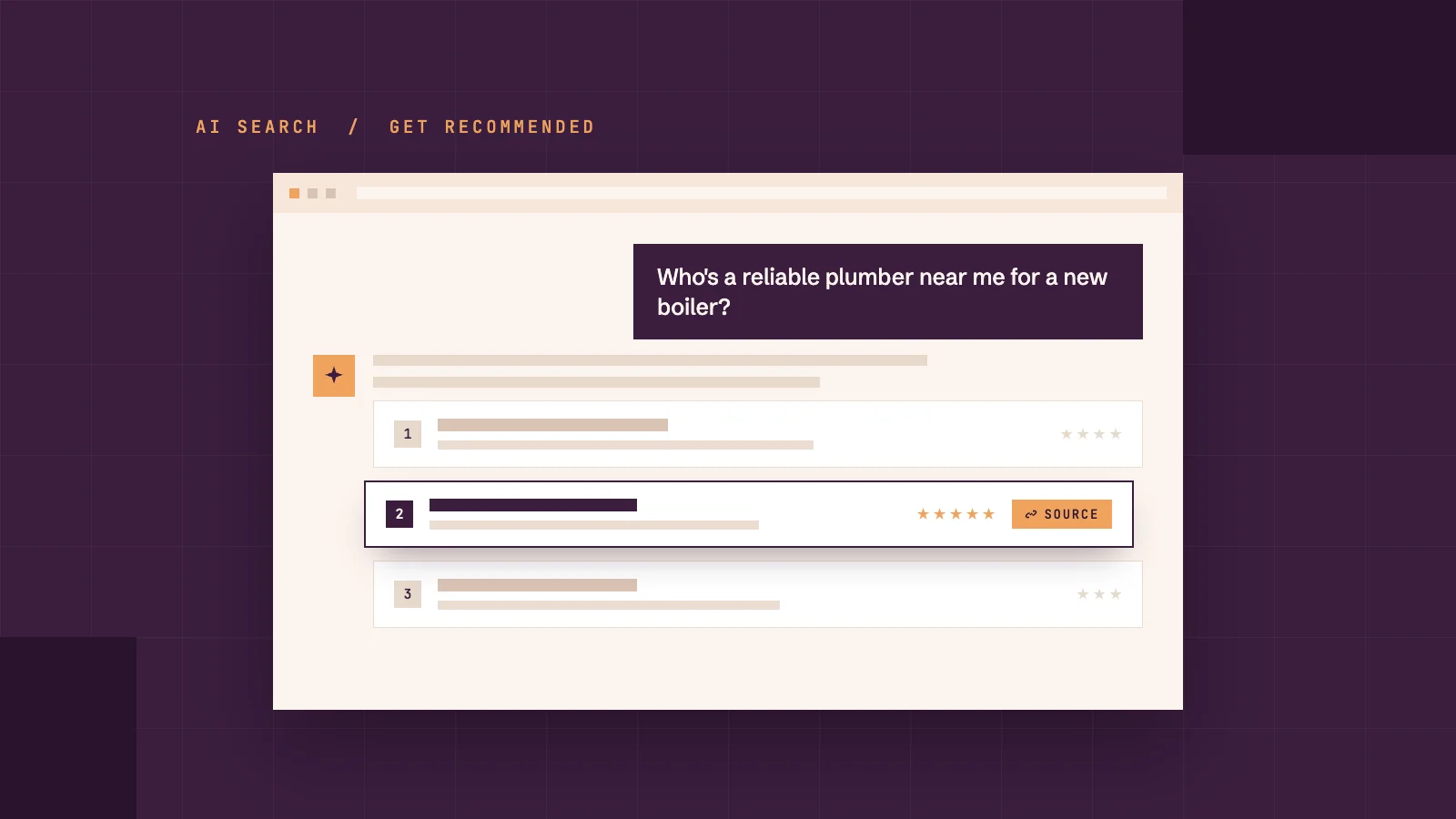
When a customer asks ChatGPT to recommend an accountant in Somerset who understands buy-to-let landlords, it doesn't return a page of links. It names two or three firms and explains why each one fits. To get recommended by ChatGPT, Google's AI Overviews or Gemini, your business needs to be one of the names these tools can find and confidently quote.
Small businesses have a better chance here than in traditional search. AI tools favour clear, specific answers over big budgets, and most local firms haven't adapted their websites yet.
This guide explains how AI search chooses which businesses to recommend, why smaller businesses have a better chance of being cited, and the practical steps a trades firm, café, solicitor, care home or other service business can take today to improve its chances.
Quick answer:
While no one can guarantee you'll be mentioned in AI search, you can improve your chances of being recommended by ChatGPT or other LLM-based AI tools. First, make sure their crawlers can reach your website (OAI-SearchBot for ChatGPT, Googlebot for AI Overviews, Google-Extended for Gemini); if they're blocked, they can't cite you. Next, answer customers' questions with concrete facts, build your reviews and directory listings, and keep a monthly report of where you appear.
On this page
How AI search decides which businesses to mention
Why smaller businesses have a real chance
Step 1: Let AI search tools reach your website
Step 2: Map the questions your customers ask
Step 3: Turn your key pages into clear answers
Step 4: Build your reputation beyond your website
How AI search decides which businesses to mention
When a question needs current information, ChatGPT searches the web before it answers. According to OpenAI's own help guide, it rewrites the question into targeted search queries, sometimes using third-party search providers, then builds its reply from what it finds and links to the pages it used. Google's AI Mode works in a similar way: Google describes it as breaking a question into subtopics and running many searches at once, a technique it calls query fan-out.
This matters because of how people now phrase their questions. When our SEO specialist and content writer attended HubSpot's AI search webinar on 20 October 2026, HubSpot senior product manager Danny explained that the average ChatGPT prompt runs to 20 to 30 words, compared with three or four for a typical Google search. A question such as "care home near Taunton with dementia support and open visiting" holds several needs at once. An AI tool may split it into separate searches for location, specialist care and visiting policy, so a page that clearly answers just one of those can still be read and quoted.
One question, several searches
“care home near Taunton with dementia support and open visiting”
location
specialist care
visiting policy
Two outcomes are worth separating. Your website is cited when the AI uses it as a source and links to it. Your business is recommended when it's named in the answer itself. The two often go together, but not always: a business can be recommended on the strength of its reviews or a local roundup article without its own site being cited at all.
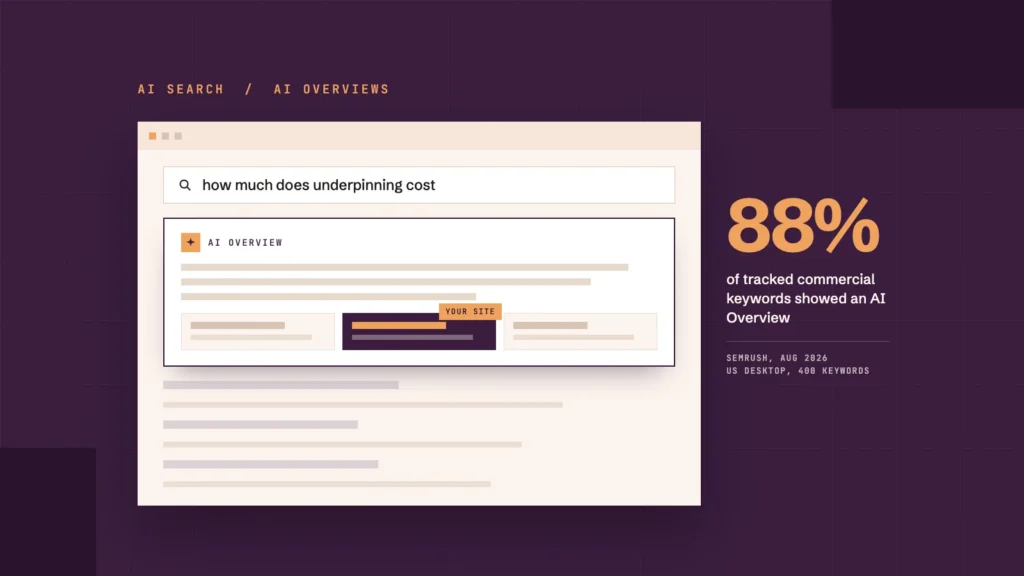
The audience is already large. Ofcom reported in December 2025 that around 30% of UK searches now show an AI Overview, and that ChatGPT received 1.8 billion UK visits in the first eight months of 2025, up from 368 million in the same period a year earlier.
Why smaller businesses have a real chance
In traditional search, an established website with years of links behind it has a head start that a small firm struggles to close. AI answers loosen that advantage. Because the tools are looking for the best match to a detailed question, a specialist page that answers it precisely can be chosen over a larger site with a general one.
Rachel Decker, co-founder of the software company ClearSync, gave an example at the same HubSpot webinar. Her business launched in 2025 with little search authority, and she said its first customer from ChatGPT arrived roughly three months after she published one article aimed at a specific question. She now attributes around 60% of new customers to AI search. That's one company's self-reported figure in a software niche, so it says more about what's possible than what's typical, but the principle behind it applies to a plumber, a solicitor, a window installer, or a tour guide company just as well: own a narrow subject and answer it better than anyone else.
Reputation beyond your website counts too. When Ahrefs analysed 75,000 brands in 2025, the brands mentioned most often across the web were far more likely to appear in Google's AI Overviews (a correlation of 0.664) than those with the most backlinks (0.218). The study looked at established websites and shows correlation rather than cause, but it points in the same direction as the advice in this guide: be specific on your own site, and make sure other trusted sources talk about you too.
Our step-by-step guide on how to get cited by AI
Step 1: Let AI search tools reach your website
This is one of the quickest steps to check, and one of the easiest to miss. AI tools can only cite pages their crawlers are allowed to read.
We learned this first-hand on Booked Wild, our sister site. When we asked Claude to analyse one of its pages, it reported that it couldn't fetch the site. The cause wasn't the website itself: an AI crawler policy in Cloudflare, the service that sits between the site and its visitors, was blocking Claude from crawling it. Once our developer updated the policy, Claude could access and crawl the site again. They also added a proper robots.txt file and sitemap to help search engines and AI crawlers find the site's content, and fixed a couple of related indexing issues while they were there.
The lesson applies to any business: a block can sit in your hosting or security settings rather than on your website, and nothing on the site will warn you it's there. Asking an AI tool to read one of your pages is a quick first test, though it only tells you about that one tool.
You don't need to be a developer to check this. Set aside 15 minutes and work through these four checks.
Look at your robots.txt file. Type your web address followed by /robots.txt into your browser, for example, yourbusiness.co.uk/robots.txt. This short text file tells crawlers what they can visit. Look for a line reading User-agent: followed by OAI-SearchBot, PerplexityBot, ClaudeBot or Googlebot, with Disallow: / underneath it. That pair blocks the named crawler from your whole site. User-agent: * means every crawler, so Disallow: / under that blocks everything. If there's no file at all, crawlers can usually visit, but it's still worth adding one that points to your sitemap, as we did on Booked Wild.
Ask an AI tool to read one of your pages. Paste a page address into ChatGPT, Claude or Perplexity and ask it to summarise the page. If it says it can't access or fetch it, something may be blocking it. That's exactly how we spotted the problem on Booked Wild. It's a useful warning sign rather than proof, because it only tests that one tool.
Check your Cloudflare or hosting settings. If your site uses Cloudflare, log in, open your domain and look for its AI crawler or bot settings, then make sure search crawlers aren't blocked. If you're not sure whether you use Cloudflare, or your site sits with another host, ask whoever manages your website: "Do any of our security settings block AI crawlers such as OAI-SearchBot or ClaudeBot?"
Check that Google can index your key pages. In Google Search Console, paste a page address into the URL Inspection tool to confirm it's indexed. Google says AI Overviews and AI Mode have no extra requirements beyond normal search, so a page Google can index is eligible for its AI answers too.
Which crawlers should you allow?
ChatGPT search
OAI-SearchBot
AI Overviews & AI Mode
Googlebot
Gemini
Google-Extended
Not every AI crawler does the same job. OpenAI's documentation explains that OAI-SearchBot is the one that needs access for ChatGPT search, while blocking GPTBot only stops your content being used to train its models. Google's AI Overviews and AI Mode use Googlebot, the same crawler as normal search. Gemini is controlled by a robots.txt setting called Google-Extended, which decides whether your content is used to train Gemini and ground its answers, without affecting your Google Search listings.
If this feels too technical, or you're short on time, it's often quicker to ask a professional. We can check it for you as part of our SEO services.
Step 2: Map the questions your customers ask
With traditional SEO, keyword tools show roughly how many people search for a phrase each month. Nothing equivalent exists for AI prompts, because OpenAI and Google don't publish what people type. You have to work out the questions from what your customers already tell you.
The best sources are close at hand: enquiry emails, phone calls, questions asked at the counter or on site visits, your reviews, and the search terms in Google Search Console. Write each question as a full sentence, with the details a real customer would include. Location matters most for local businesses, because "best café" and "best café in Clifton" produce entirely different answers.
The examples below show the level of detail to aim for in the sectors we design websites for:
Sector
A question a customer might ask AI
I need a new boiler in a three-bed semi in Bristol. Who's reliable, and roughly what will it cost?
Dog-friendly café in Clifton with vegan options where I can work for a couple of hours
Accountant in Somerset who specialises in landlords with two or three rental properties
Solicitor in Bath for a commercial lease dispute who offers a fixed-fee first meeting
Care home near Taunton with dementia support and open visiting hours
Interior designer for a kitchen extension in a Victorian terrace, budget around £40,000
Groundworks contractor for a single-storey extension in North Somerset
Independent financial adviser near Exeter who can help combine old pensions
Aim for 20 to 25 questions to begin with, spread across your main services, customer types and areas. Include several versions of your most important question. Answers vary from one run to the next, so a group of related questions gives a far more reliable picture than one question checked once.
Step 3: Turn your key pages into clear answers
Once you know the questions, check whether your website actually answers them. Many small business sites describe the company well but leave the customer's practical questions unanswered, or bury the answers in long paragraphs about values and experience.
Lead with the answer
AI tools tend to lift short, self-contained passages. Use the customer's question as a heading where it reads naturally, answer it in the first sentence or two, then add the detail. A section headed "Our approach" tells an AI tool almost nothing about what it contains. "How much does a new boiler cost in Bristol?" matches the question a customer is asking.
Keep to one question per section, so each answer still makes sense when it's quoted on its own.
Replace general claims with facts
Compare two sentences. "We pride ourselves on quality workmanship" gives an AI tool nothing to repeat. "We cover Bristol, Bath and North Somerset, and most kitchen fits take two to three weeks" answers three questions at once. Prices or price ranges, areas covered, typical timescales, accreditations, opening hours and who a service is best suited to are the details that turn a page into a source.
Give each service and area its own page
A single services page that lists everything can't answer a specific question as well as a dedicated page can. For Dart & Co Foundations, a specialist piling contractor, we built separate pages for each region they serve. Their published results show a 129% rise in organic traffic over 12 months and top-five Google positions for priority searches such as "piling contractors London".
Those figures come from traditional search, not AI, so they don't prove anything about AI citations. They're relevant because Google's AI features draw on its normal search index, and pages that clearly answer "who does this, and where?" are exactly the material an AI tool needs when a customer asks that question.
Use structured data accurately
Structured data, or schema markup, is code that describes what's on a page to search engines. Google says no special schema is needed for its AI features, and that any structured data must match what's visible on the page. We add it anyway, as a matter of habit, because it's a dependable way to describe a business clearly. That means FAQ, article and video schema on the pages we create for clients, and job schema on Abney & Baker's vacancies so their roles can appear in Google Jobs. It won't guarantee an AI mention, but it helps search engines understand exactly what each page contains.
Step 4: Build your reputation beyond your website
Your own website is only one of many places AI tools read. At the HubSpot webinar, Danny estimated that a business's own site typically accounts for between 1% and 8% of the sources AI cites for the questions that business cares about. The rest comes from reviews, directories, social platforms and other people's articles, and for local businesses a few of those carry particular weight.
Google Business Profile and reviews
Google lists an up-to-date Business Profile among its best practices for AI features, so check your hours, services, categories and service areas are accurate. Reviews appear to matter as well. In a 2026 study, AI visibility software company Insites ran 10,000 US local businesses through ChatGPT and Perplexity and found that the businesses recommended had an average of 133 Google reviews, against 11 for those left out, while star ratings differed much less. It's vendor research with a thinly described method, and it shows an association rather than a cause. Even so, a steady flow of genuine reviews costs little and helps in ordinary search too.
Directories and professional bodies
AI tools look for corroboration, and sector directories are where much of it comes from. Make sure your details are complete and consistent wherever your customers already check, such as TrustMark or Checkatrade for trades, the CQC website for care providers, or your professional body's member directory. Keeping these updated regularly also helps AI tools quote relevant and accurate information.
LinkedIn and YouTube
The HubSpot speakers said they regularly see LinkedIn posts and YouTube Shorts cited in AI answers. Shorts are one of the top cited answers by Gemini, while Facebook and Instagram almost never appear. That makes a short LinkedIn post or a 40-second video answering one customer question a better use of time than you might expect. If you have blog content turning it into a social media post, reel, or Short gives it a second chance of being found.
The articles AI already trusts
When you test your questions in ChatGPT or Perplexity, note which articles appear as sources. If a local guide or industry roundup keeps coming up, contact the publisher, explain why your business belongs in it and offer to write the paragraph. Rachel described using this approach at ClearSync and if done well, it could not only earn a valuable backlink but a mention in a source AI already relies on.
How to tell whether it is working
AI visibility is harder to measure than search rankings, so use a few signals together.
The most direct is a monthly test. Run your list of questions in ChatGPT, Gemini and Perplexity and record whether your business is named, which competitors are, and which sources are cited. Tracking tools such as HubSpot's AEO tool or SEMrush can automate this as your list grows.
Analytics only tell part of the story. Google Analytics shows visits referred from sites such as chatgpt.com and perplexity.ai, and Google includes traffic from AI Overviews and AI Mode within the web search data in Search Console. But many people who see your business in an AI answer will search for your name or ring you directly instead of clicking a link. Adding "ChatGPT or another AI tool" as an option to a "How did you hear about us?" question on your enquiry form captures that influence.
This visibility check and additional question on your forms is well worth the effort. Semrush estimated in 2025 that the average visitor from AI search is worth 4.4 times the average visitor from traditional organic search, based on conversion rate. Whilst it mainly focused on digital marketing and SEO topics, it gives a good indication of where search and leads are heading.
It also shows that a customer who arrives after a conversation with an AI tool has usually done much of their research already.
Mistakes to avoid
Publishing AI content in bulk.
It's tempting to publish lots of quickly generated content in the hope that volume wins. But the truth is low-quality content is quickly dropped from AI answers and is more likely to get you penalised by Google. Using AI to help draft is fine, but every page still needs to be humanised, accurate, specific and written for the customer.
Paying for guaranteed placement.
Be cautious of anyone offering guaranteed placement in ChatGPT answers. No one controls what these tools recommend, and the results change from week to week.
Buying AI-only extras before the basics.
Google states that you don't need AI text files or special markup to appear in its AI features. The groundwork that earns AI recommendations is the same work that helps customers find you through ordinary search.
Where to start this week
You don't need to overhaul your website to make progress. These are the biggest quick wins you can start today:
Check your robots.txt file and hosting settings so AI crawlers can reach your website
Write down ten questions your customers regularly ask
Make sure your most important service page answers the main question plainly, with the facts a customer needs to decide
Ask a handful of recent, happy customers for a Google review
Once those are done, run your questions through ChatGPT in an incognito window and see where you stand. That baseline makes every later improvement easier to judge.
If you'd like help, we can check whether AI crawlers can reach your website and review how well your key pages answer the questions your customers ask.
Find out more about our SEO services for small businesses, read our guide to local SEO, or book a discovery call.
Frequently asked questions
Is AI search optimisation different from SEO?
Mostly in emphasis. SEO aims to rank your pages in search results, while AI search optimisation, also called answer engine optimisation (AEO) or generative engine optimisation (GEO), aims to have AI tools quote and recommend you. The foundations overlap heavily: Google says its normal SEO best practices apply to its AI features. The main differences are a stronger focus on direct answers, structured content, and on your reputation beyond your own website.
How long does it take to appear in AI answers?
There's no fixed timescale and no guarantee. HubSpot's AEO guidance suggests early signs within four to eight weeks and clearer business impact over six to 12 months.
Does ChatGPT use Google reviews when it recommends local businesses?
OpenAI doesn't publish exactly where it gets local business information. Website builder Zarla, which checks AI answers for its own customers, has noticed that ChatGPT's local recommendations often quote ratings and review counts matching Google Business Profiles, though that's an observation rather than a confirmed data source. OpenAI's help pages also mention partners such as OpenTable and Yelp for restaurant bookings, although Yelp bookings are only available in the US and Canada. Keeping your reviews healthy on Google and on the platforms your sector uses covers the most likely sources.
Should I block AI crawlers to protect my content?
You can limit how your content is used without disappearing from AI search. Blocking OpenAI's GPTBot stops your content being used to train its models, while allowing OAI-SearchBot keeps you eligible for ChatGPT search. Google's Google-Extended setting controls whether your content is used to train Gemini and ground answers in the Gemini app, but it doesn't control AI Overviews or AI Mode, which follow normal Search rules through Googlebot.
Do I need an llms.txt file or special schema?
Not for Google. Google itself says there's no special schema and no AI-specific text file needed to appear in AI Overviews or AI Mode. Accurate structured data for your business, reviews or vacancies is still worth having for normal search, and is a better use of your time.
What should I do if ChatGPT gets details about my business wrong?
Open the sources listed under the answer to find where the wrong information came from. It's often an out-of-date directory listing, an old Google Business Profile entry or an outdated page on your own site. Correct those sources and keep your details consistent everywhere, then check the answer again after a few weeks.