AI in web development is moving quickly, and the companies behind the tools are changing just as fast. Meta's purchase of the AI coding startup Conductor is the latest example. For service businesses, the more useful question is what happens to websites built with these tools when the companies behind them change direction.
If you're paying for a new website, that raises practical questions about who owns the finished site, whether you can still edit it if an AI tool disappears, and how far to rely on technology that's still developing. They're worth asking before you choose who builds your WordPress website. The tools used during development matter, but so does the platform your finished website runs on and your ability to manage it in future.
Nivo Digital uses AI-assisted development, and we rebuilt our own website with Claude and Elementor MCP. That experience shapes how we see this deal, and what it means for businesses paying for website development and ongoing support.
Quick answer
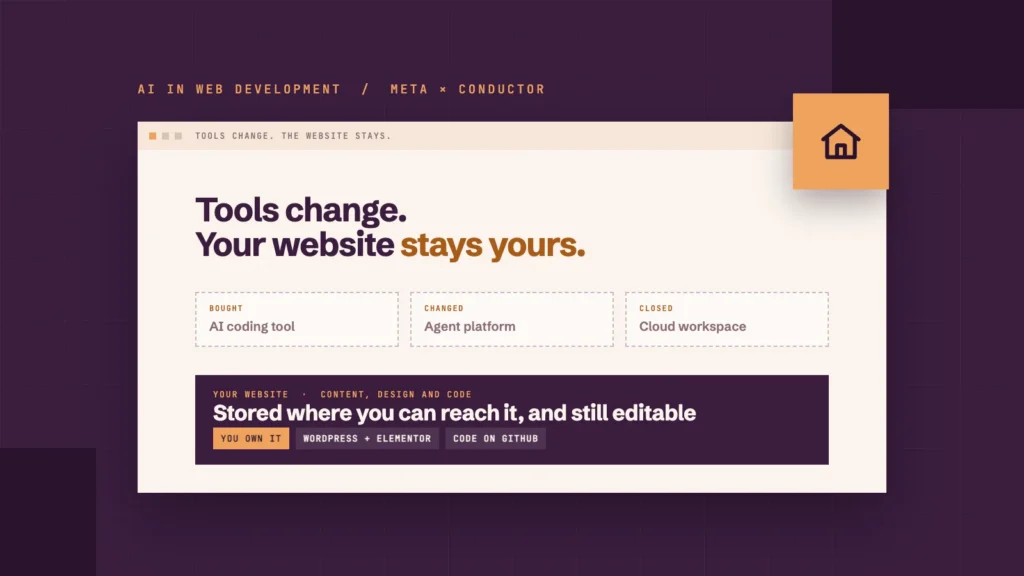
Meta's Conductor deal shows how quickly AI development tools can change, but websites built with them don't disappear when a tool does. What matters is where your website's content, design and code are stored, who owns them, and whether they stay editable without the original AI tool. Your finished website shouldn't depend on any one company staying in business.
What has Meta actually acquired?
Meta has bought Conductor, a startup whose platform lets software developers run several AI agents at once, each working on a different part of a project.
TechCrunch reports that Conductor was founded in 2024. It doesn't build its own AI models. Instead, it organises agents from companies including Anthropic and OpenAI, so a developer can split a larger task into separate jobs that run side by side rather than one after another.
Meta confirmed the acquisition but hasn't disclosed the price, terms or plans for Conductor's technology. It fits a wider push: Meta launched its own coding agent, Muse Code, in August 2026 and has made several AI acquisitions over the past year.
Existing Conductor customers face immediate changes. Conductor Cloud becomes read-only on 13 November 2026 and closes on 20 November, after which user cloud data will be deleted. Core features continue until early 2027, when the company has promised something new. Users can move their cloud workspaces to its local app.
That's why the deal matters to website owners. It shows how much a development workflow can depend on a single tool, and how little notice there can be when that tool changes.
What does this mean for AI in web development?
AI in web development is moving towards tools that take on bigger, more complex jobs, including splitting a project into separate tasks for several agents at once.
For website projects, that could eventually change how agencies handle builds with multiple templates, integrations and features. Work done one step at a time could be shared between agents. Using several agents doesn't automatically make a website faster or better, though. The pieces still need to fit together, and someone needs to check that they do.
Nivo Digital hasn't yet used several AI agents working independently on the same website build. We use Claude Code, or Claude with Elementor MCP, to help with development, while our team guides the work, reviews the output and tests everything before it goes live.
There's also a difference between AI generating a website and AI creating something that becomes part of the website's real structure. Elementor's MCP connection lets AI tools, including Claude, Codex and Cursor, work with Elementor, and Elementor says anything built through it is real, editable Elementor structure. The result isn't a mock-up. It becomes part of your website, and you can edit it in Elementor like any other page. Our guide to converting HTML to Elementor goes into this in more detail.
When you're weighing up AI website development, that's the distinction to look for: a finished website you can keep using and managing, rather than one that only works through the tool that made it.
If you're planning a new Elementor website or need help with an existing one, see our Elementor services.
Will AI replace web developers?
No. In our experience, AI changes the work involved in building a website, but someone still needs to direct it, review it and test it.
Tools like Claude Code and Elementor MCP help with development tasks. They don't decide how a website should work, what its visitors need or whether the finished result does its job. A service business website has to explain what you offer, help visitors find the right service and make it easy to get in touch. Generating the pages is only part of that.
Building with AI still involves:
Planning: deciding what the website needs to achieve and how its pages and features fit together.
Direction: giving AI tools clear instructions and choosing the development approach.
Review: checking the layouts, content and functionality rather than accepting everything the tool produces.
Testing: making sure the finished website works as expected before it's published.
Ongoing care: making changes, keeping the website up to date and fixing problems as they come up.
Someone also has to take responsibility when something doesn't work as intended. When you choose an agency, how it manages and checks the work matters more than how much AI it uses. See how we work for the checks involved from planning to launch, or read our post on AI in web design.
What happens to your website if an AI tool disappears?
It depends on where the finished work is stored and how it was built. Conductor's cloud service is closing, so its users need to move their workspaces to keep using them. That changes how they work, but it doesn't switch off the software they've already built. Websites work the same way.
We asked Nivo Digital's Website Manager, Sadie O'Callaghan, what would happen to the websites we've built if Claude Code or Elementor MCP disappeared tomorrow. Every website would stay, including its content, design and functionality.
WordPress websites built with Elementor MCP are saved in WordPress and Elementor, so we'd keep editing them in Elementor as normal, without the AI connection.
Websites built with Claude Code are stored in GitHub and deployed through platforms such as Cloudflare Pages, so the code can still be edited by hand or with other development tools.
The difference would be speed. New features and bigger changes would take longer, but no existing website would be lost.
That's the test for any AI-assisted build: the AI tool can help create your website, but it shouldn't be the only place the finished website exists. Where your website lives depends on the technology. A WordPress and Elementor website has a different editing setup from a custom-coded one, so ask how yours is stored and maintained. If your Elementor website needs changes or fixes, our Elementor support team can help.
Who owns your website when AI builds it?
Agree on who owns the finished website before a project starts, whether the agency uses AI, traditional development or both.
Owning a website isn't the same as having access to the tools used to build it. An agency might use several tools along the way, but you shouldn't need any of them to reach your finished website. A WordPress website built with Elementor should be editable in WordPress and Elementor, whether or not an AI tool helped create its pages. A custom-coded website should have its files stored where the right people can reach and maintain them.
Nivo Digital clients own their website and domain outright, and that doesn't depend on any AI tool or development platform. We built our own website the same way: AI helped with the rebuild, but the finished pages are ordinary Elementor pages that we open, edit and manage like any others.
AI can help build a website, but it shouldn't decide who controls it afterwards.
What should you ask your web agency?
Ask how your website will be stored, accessed and looked after if the tools used to build it change. You don't need every technical detail, but you should get clear answers to these six questions.
Who owns my website and domain?
Make sure ownership is written down and that you have the access you need.
Where is the finished website stored?
For a WordPress website, check that the content, layouts and functionality are saved in WordPress and can be edited through WordPress and Elementor. For a custom-coded website, ask where the files are kept.
Could my website be maintained without the original tools?
Ask what files, access and documentation exist, so your website isn't tied to how it was first built.
What happens if an AI tool is discontinued?
Ask whether your website would keep working and what would change about editing or developing it. A good agency can explain the difference between losing a development tool and losing your website.
Who checks the work before it goes live?
Find out how AI-generated code, layouts and features are reviewed, and who tests the finished website.
How will my website be looked after once it's live?
A website needs regular updates and checks after launch. Website care plans give you a clear arrangement for ongoing support, and we also offer Elementor maintenance for Elementor websites.
These questions apply whether your agency uses AI heavily or hardly at all. You're investing in a website for your business, and it should stay yours to use and manage.
What should you do next?
Make sure your website will outlast the tools used to build it. Meta's Conductor deal is a reminder that AI development tools can be bought, changed or closed quickly, and what's available today may look different next year.
AI can help agencies build websites and add new features, but your website should stay accessible, editable and maintainable without depending on one AI tool. That's how Nivo Digital works. We use AI where it helps; our clients own their websites and domains outright, and our WordPress and Elementor builds stay editable in the platforms they were built in.
If you're planning a new website or want to understand how your current one is built and looked after, we'd be happy to talk it through.
FAQs
Does Meta own Conductor now?
Yes. Meta confirmed it has bought Conductor, an AI coding startup founded in 2024. It hasn't disclosed the price, terms or product plans.
Is this the same Conductor as the SEO platform?
No. This Conductor is the AI coding startup. A separate company called Conductor sells SEO software, and the reports of this deal don't involve it.
Can I still edit my website if the AI tool used to build it disappears?
Yes, as long as the finished website is stored on a platform you can access, or its files are available separately from the AI tool. Websites built with Elementor MCP are saved as editable Elementor structure in WordPress, so you can keep managing them in Elementor.
Who owns my website if an agency uses AI to build it?
Ownership should be agreed in your contract with the agency. Using AI during development doesn't change who owns the website. Nivo Digital clients own their website and domain outright.
What happens to Conductor users after Meta's acquisition?
Conductor Cloud becomes read-only on 13 November 2026 and shuts down on 20 November 2026, after which user cloud data will be deleted. Users can move their cloud workspaces to the local app. Core features continue until early 2027, when the company has promised something new.
Is AI website development suitable for a service business?
Yes, as long as the finished website meets your business's needs, stays editable and can be looked after without depending on the tools used to build it. Nivo Digital uses AI-assisted development on WordPress and Elementor websites.