When companies like Squarespace, Wix and Webflow are cutting their own workforces as they reorganise for a market that AI is changing so quickly, it's fair for a small business owner to ask: do I need a web designer, or will an AI website builder do the job?
At Nivo Digital, we build websites with AI every day, and for some businesses an AI website builder is the sensible choice. For many of the industries we work with, though, a builder on its own doesn't cut it. What decides which you need is what your website has to do for you, much more than how good the tools are.
Quick answer
You may not need a web designer if you want a simple website with basic functionality and have a limited budget. An AI website builder can handle that, as long as you check everything it produces. If your website has to bring in enquiries, sell products or connect to other systems, we'd recommend an experienced web designer, developer or agency. And if you've already designed your site with an AI tool, we can build your AI design as a proper WordPress website.
On this page
What do the website builder job cuts tell us?
Are AI website builders good enough for a small business?
When does your business need more than an AI builder?
What happens when AI builds real business websites?
What should you check before you publish an AI-built website?
Which route suits your business?
What do the website builder job cuts tell us?
Less than the headlines suggest. The companies behind these tools are reorganising, but that doesn't mean AI replaced their staff, or that hiring a web designer is suddenly pointless.
Most of Squarespace's job cuts landed on its product and engineering teams, the people who build its software. Chief executive Anthony Casalena talked about smaller teams and a simpler structure, and said in a memo to staff that the company's product and industry were going through fundamental change. He didn't say what part AI played, if any, and Squarespace told Investing.com it wouldn't link the restructuring to plans for more AI infrastructure spending.
Wix and Webflow were more direct. Wix cut about 20% of staff in May, Webflow restructured the same week, and both pointed to AI when they explained why. Squarespace is heading the same way with Forma, a platform still in development that's designed to build websites and apps through conversation.
These tools are changing fast, so judge any builder on what it can do for your business right now, rather than on features that have only been announced.
Are AI website builders good enough for a small business?
For some businesses, yes. If your website's main job is to show you're a real business and tell people how to reach you, an AI website builder can do that well. Our team's view is that these tools suit small businesses that are just starting out, need a simple site with basic functionality and have a limited budget.
That might be you if:
You only need a few pages covering who you are, what you do and how to get in touch.
Most of your work comes through word of mouth, so your website mainly needs to show your work, not win new leads.
You're testing an idea and want something online before you spend more.
You don't need bookings, payments or connections to other software beyond what the builder includes.
You've got time to write, check and update the content yourself.
Speed is where these tools shine. In one independent hands-on review, Squarespace's Blueprint AI took a made-up bike repair shop from the first question to a finished site in under three minutes.
The same review also shows the catch. That site looked complete, but it was full of sample products, invented prices and AI-generated people. Whichever builder you use, a finished-looking website isn't finished until every detail has been checked, as our sister brand Booked Wild explains.
When does your business need more than an AI builder?
Your website needs more than an AI Website Builder when it has a job to do or needs to keep the existing rankings you already have. If it needs to bring in enquiries, sell products or connect to other systems, we'd highly recommend using an experienced web designer, developer or agency.
An AI builder only knows what you tell it. It doesn't know who your best customers are, which jobs you want more of, or what happens after someone fills in your form. Those answers come from proper conversations about your business, and they shape everything that goes on the site.
Two projects from our own work show what that looks like in practice:
Two audiences, one website. Abney & Baker, a home care provider, needed its website to work for two very different visitors: people arranging care, and people looking for work as carers. Each group arrives with different questions and needs a different next step. That meant UX research and prototypes before anything was built, then separate routes through the site for each audience. Recruitment got its own section too, with vacancies marked up with job structured data so they're eligible to appear in Google's job listings. A builder will give you a home care template, but it won't work out that some of your visitors are looking for a job, not care. Read the full case study.
A big decision, made simpler. A luxury holiday is a considered purchase, and Safari & Beach's visitors needed help narrowing down their options before getting in touch. We added filtering by destination and itinerary, simplified the enquiry forms and built landing pages to match its Google Ads campaigns, so people clicking an ad land on the page that answers their search query. The case study reports more ad impressions, conversions and high-quality enquiries after the new website launched. That came from planning the site, the forms and the ads together, which isn't something a builder's template does for you.
Replacing an existing website can put your search rankings at risk, because page addresses change. Our website redesign SEO checklist covers what needs protecting, and why it's worth having someone experienced handle the move.
What happens when AI builds real business websites?
In our experience, AI gives you a strong starting point, but the finer details still need a person.
We rebuilt our own website using Claude and Elementor MCP, and it launched with 71 pages, 50 reusable sections and 10 components. We've also used Claude Code across several client projects, from page layouts, navigation and enquiry forms to a full static website rebuild.
On every one of them, our team decided the structure, design direction, user experience, content requirements and functionality. AI handled much of the build, while we reviewed every page, made refinements where needed, tested everything and managed the launch.
The fixes were often small, but they were the kind your visitors would notice:
On our own site, layouts, spacing and responsive styling needed refining to look right on every screen size. The early pages also looked obviously AI-generated, with the same blocks repeated on every page, so we built a library of section layouts and gave each page a design that suited its purpose.
On one client's landing pages, we had to adjust mobile layouts, forms and functionality. Landing pages only earn their keep if they turn visits into enquiries, so we also tested the forms and checked that conversion tracking was recording correctly.
That second example is the one to remember. A broken form or missing tracking can look perfectly fine on screen. You'd only find out when the enquiries didn't arrive.
Catching problems like that before your customers do comes down to who's directing the work. These projects used AI development tools directed by an experienced team, which is a very different thing from using a consumer website builder on your own. You can see exactly how we worked in our behind-the-scenes account of the rebuild.
What should you check before you publish an AI-built website?
Check every fact, every form and every page on your phone. If you do go down the AI route, these are the things most likely to catch you out.
Replace all the sample content. Look for placeholder text, generated or stock photos of people posing as your staff, sample prices and leftover details in the footer.
Read every claim as if a customer will rely on it. AI can add details you never gave it. In the same Squarespace review, it described pottery as food-safe without being told. Pay close attention to accreditations, guarantees, prices, opening hours and reviews.
Send yourself a test enquiry. Fill in every form, then check the message lands in the right inbox.
Use it on your own phone. Tap the menu, buttons and phone number, and look for anything cramped or cut off.
Rewrite your page titles and descriptions. That review also found AI-written search titles that read like sales slogans, and descriptions promising content the site didn't have.
Try it without a mouse. Move through the site using only the Tab key. Automated accessibility checks catch some problems and miss others.
Protect what you already have. If you're replacing a site, redirect your old page addresses to the new ones.
Make a change yourself. Update your phone number and add a page, so you know you can do it when it counts.
Find out what you can take with you. Some hosted builders limit what you can export, so check before you commit.
Which route suits your business?
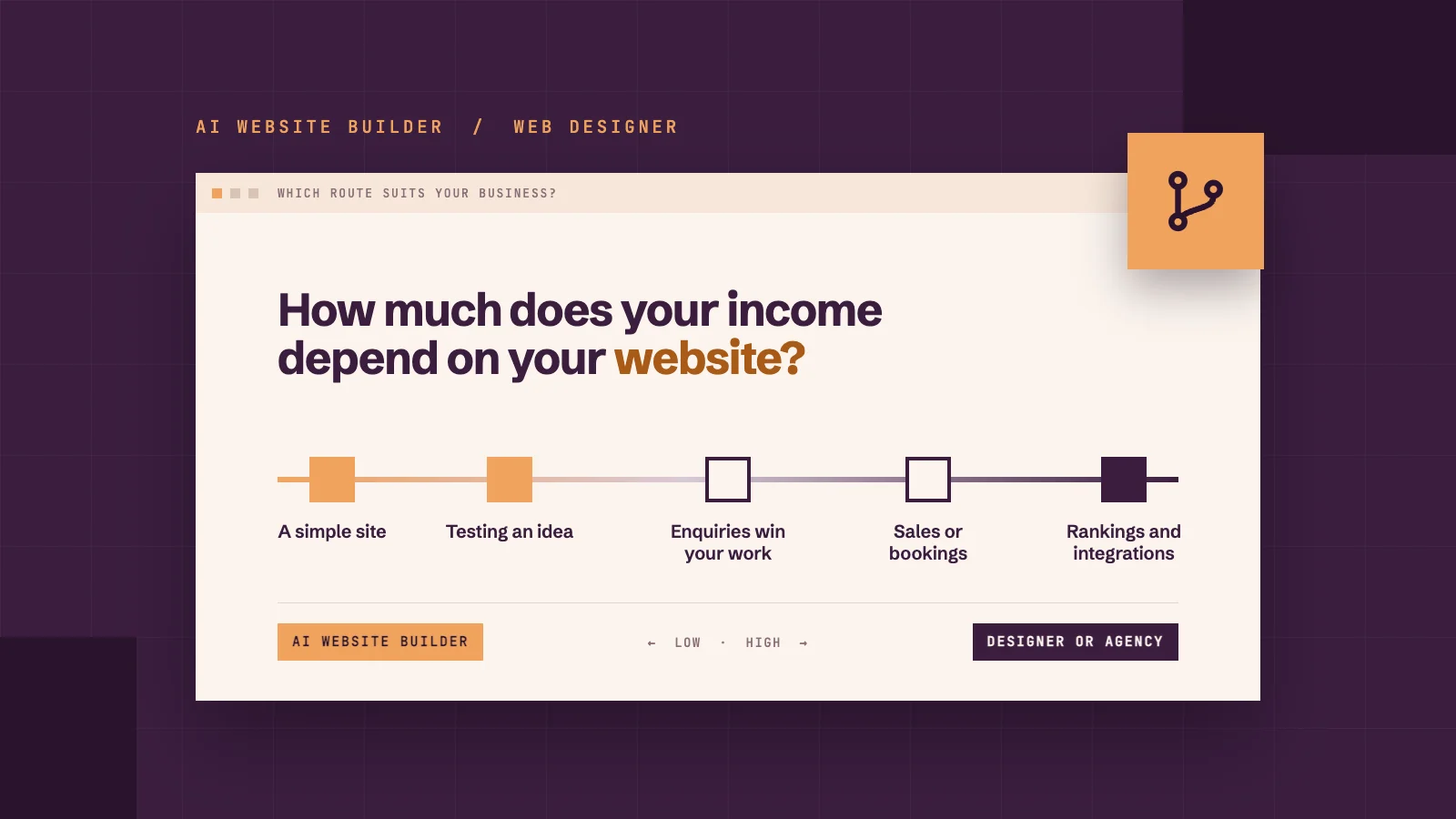
The more your income depends on your website, the more it's worth having someone experienced involved. Use this as a starting point for your next website build.
Your situation
Route we'd consider
Why
You need a simple site and have a limited budget
Route we'd considerAI website builder
WhyThe basics are quick and affordable, as long as you check everything
You're testing a new idea
Route we'd considerAI website builder
WhyYou can find out if there's demand before investing more
Enquiries from your website are how you win work
Route we'd considerDeveloper or agency
WhyPage structure, forms and tracking directly affect the work you get
You sell products or take bookings online
Route we'd considerDeveloper or agency, or a platform built for it
WhyPayments, stock and booking rules need to be reliable
Your site needs to connect to other systems
Route we'd considerDeveloper or agency
WhyIntegrations need planning and testing
Your current site already ranks well in search
Route we'd considerDeveloper or agency
WhyA rebuild can lose rankings if addresses aren't redirected
How will you know if your website is working?
Count the enquiries, not how quickly it went live. Before you change anything, make a note of how many calls, form submissions and bookings you get each month, and where they come from. If you don't have a website yet, start counting from launch day.
Google Search Console shows which searches your site appears for, and Google Analytics can record form submissions. Check both after three months, and ask new customers how they found you. If the numbers aren't moving, you'll know what to fix or what to raise with your developer.
Is an AI website builder the right choice for you?
AI has made it quicker and cheaper to get a basic website online, and that's good news for plenty of small businesses. What it hasn't changed is the work that makes a website pay for itself: knowing your customers, planning how they'll get in touch and checking everything works before it goes live.
If you're weighing up your options, we're happy to talk them through. At Nivo Digital, we're Elementor specialists who build, host and maintain websites for service businesses, using AI where it helps. Tell us what your website needs to do, and we'll give you a straight answer, even if that answer is to use a builder.
FAQs
Can AI build a business website for free?
You can generate one for free, but publishing it properly usually costs money. Wix includes its AI builder on its free plan, while Squarespace's 14-day trial lets you build but not publish. Using your own domain generally means a paid plan, so check current pricing before you start.
Did AI cause the Squarespace job cuts?
Squarespace hasn't said so. Its chief executive linked the cuts to changing how the company works and to fundamental change in its industry. AI is clearly part of the backdrop, as the company is building AI products, but it hasn't said what role AI played in the decision.
Will AI replace web designers?
We don't think so, at least not for websites that have a commercial job to do. AI is taking on more of the production work, but deciding what a website should do, how it should work and whether it's good enough still takes experience.
Are AI-built websites bad for SEO?
Not automatically. The risks are generic content, inaccurate claims, weak page titles and lost rankings if you replace an existing site without redirects. Check those as carefully as you would on any new website.
Does Nivo Digital use AI to build websites?
Yes, every day. We rebuilt our own website using Claude and Elementor MCP, and we've used Claude Code on client projects. Our team decides the structure, design and functionality, reviews everything AI produces and tests the work before launch.